YES. Standard UnInc DC Xtrm Snowboard 2025
Designed for Dustin Craven as a more precise version of the regular Standard, the exceptional YES. Standard UnInc DC XTRM Snowboard is a directional volume twin offering full camber and a stiffer feel. Super stable underfoot and smooth flexing like any good twin, things change in soft snow versus groomed terrain. The nose and tail have different volumes of material allowing the nose to float easier while still maintaining a centered stance on the sidecut. The Midbite again makes takeoffs and landings feel solid but the stepped in waist really allows the board to be quick and nimble. One of the first boards to sell out last year, and this year offered at a lower price without losing any features.
-
Flex Rating (1 = soft, 10 = most responsive)
- 7
- Forever Flex
- Forever Flex is a manufacturing process that helps stabilize the flex and rocker profile of a board for its lifetime. These boards now finish the first stages of production slightly overbuilt and then are seasoned using a specialized machinery that mimics extreme riding use. By flexing the fresh board fibers and epoxy at the factory the materials settle into their final arrangement within the board layup much the same as if you rode the board for 20 days. This process helps Yes narrow their production tolerances so the board you buy has a more accurate specified flex and rocker profile that will change less as you ride it more.
-
Suggested Use
- Powder, Freeride
-
Camber / Rocker Style
- Camber
- This is the classic camber profile where the center of the board is raised off the snow, and the contact points are closer to the bindings. Offers good edge control, stability, and pop. Can be less forgiving than other profiles, making it better for advanced riders or those who prefer a more aggressive riding style.
- Camber
-
Shape
- Directional Twin
- A directional twin snowboard combines the freestyle versatility of a twin shape with a slight directional emphasis. While featuring a symmetrical shape for switch riding, it incorporates a subtle directional aspect, such as a slightly longer nose or setback stance, enhancing performance in one primary direction. This design maintains a playful feel for freestyle maneuvers while optimizing stability and control, particularly in powder or variable conditions. Ideal for riders who enjoy the park but desire enhanced performance on groomers or in specific terrains, a directional twin provides a versatile compromise between freestyle agility and directional stability.
- Perfectly symmetrical shape for balanced riding, equally versatile both when used regular and when used in switch. Great balance between feline stability and freestyle mobility, no matter which way you point it.
- Directional Volume Twin
- Offsets floatation lost to MidBite cutting, by removing nose and tail volume, offering symmetrical flex, centered stance, and a true twin shape with more float.
- Maintains true twin shape
- Increases pow floatation
- Directional Twin
-
Core Material
- Poplar/Paulownia/Bamboo
- YES. Snowboards' Poplar/Paulownia/Bamboo core features Poplar, Paulownia and Bamboo rails. Poplar provides lightweight characteristics and consistent flex, enhancing maneuverability. Paulownia, even lighter, maintains strength with a favorable strength-to-weight ratio. Bamboo adds durability and responsiveness. This blend ensures optimal weight reduction, responsiveness, and performance, making YES. Snowboards perfect for various styles and conditions.
- Poplar/Paulownia/Bamboo
-
Construction
- Triax
- Triaxial or "Triax" fiberglass on a snowboard refers to a fiberglass construction where the fibers run in three directions - usually along the length and width of the board and at an angle. This configuration adds torsional stiffness to the board, enhancing its overall stability and responsiveness. Snowboards with triaxial fiberglass tend to have a more precise and controlled feel, making them suitable for riders who prioritize stability at higher speeds, improved edge hold, and better performance in challenging conditions. Triax fiber is often found in snowboards designed for advanced and aggressive riding styles.
- Triax
-
Edges
- MidBite
- MidBite blends the response of a narrow waist width with the stability of a wider nose and tail. The design steps a single, longer section (longer than UnderBite) of each sidewall inward between the insert packs. This single long disruption of the sidecut between the bindings cheats the waist width narrower, providing quicker edge-to-edge response. Meanwhile, from your bindings out to the end of the sidecut a wider board is maintained, which improves float in pow and is a stable platform for popping, spinning, and landing on any snow type.
- Nose and tail and wide, stable platforms
- Narrow waist creates fast edge-to-edge response
- Disrupted edge increases hold on hardpack and ice
- MidBite blends the response of a narrow waist width with the stability of a wider nose and tail. The design steps a single, longer section (longer than UnderBite) of each sidewall inward between the insert packs. This single long disruption of the sidecut between the bindings cheats the waist width narrower, providing quicker edge-to-edge response. Meanwhile, from your bindings out to the end of the sidecut a wider board is maintained, which improves float in pow and is a stable platform for popping, spinning, and landing on any snow type.
- MidBite
-
Base
- Sintered
- YES. Snowboards' sintered bases are crafted by fusing tiny polyethylene particles under heat and pressure, creating a porous, durable surface. Known for superior speed and wax absorption, these bases are favored by advanced riders for their high-performance capabilities in various snow conditions.
- Sintered
-
Binding Mounting System
- 2x4 Insert Packs
Original: $419.97
-65%$419.97
$146.99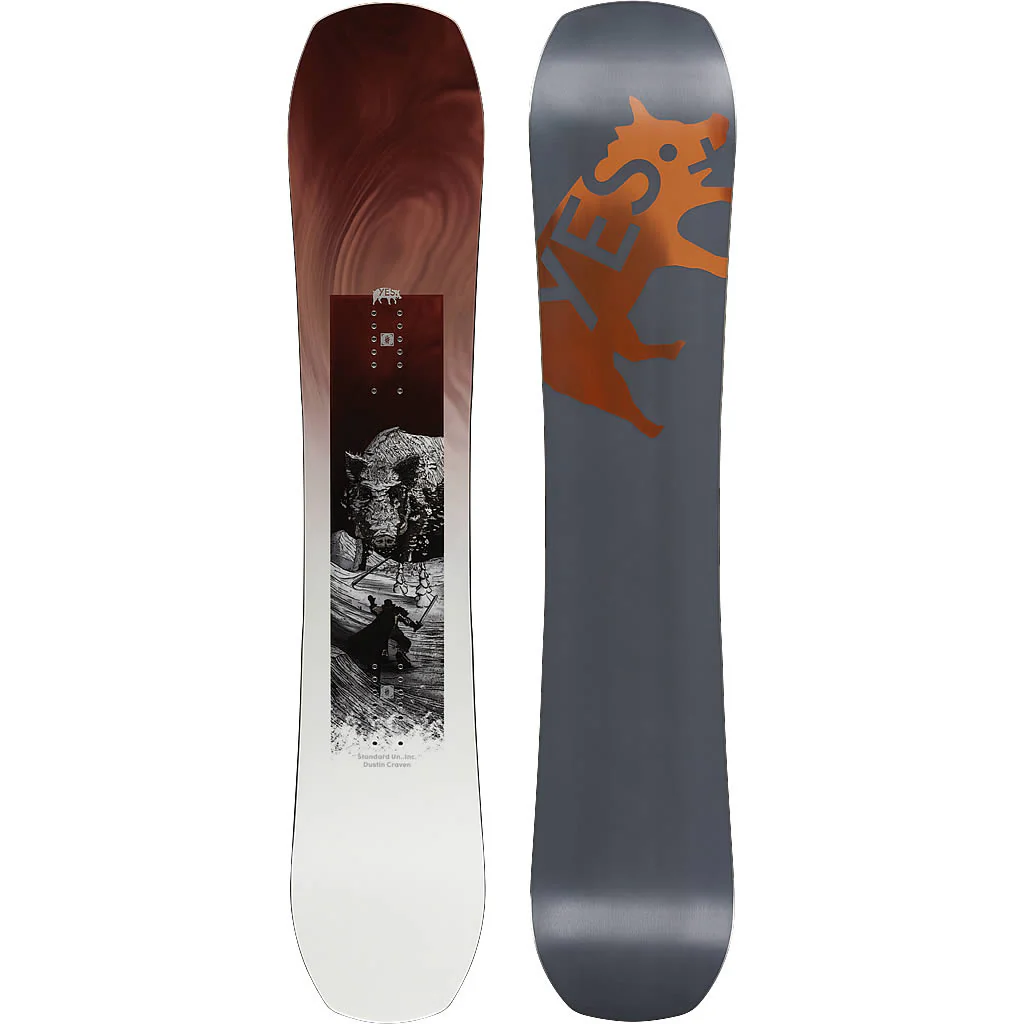
Description
Designed for Dustin Craven as a more precise version of the regular Standard, the exceptional YES. Standard UnInc DC XTRM Snowboard is a directional volume twin offering full camber and a stiffer feel. Super stable underfoot and smooth flexing like any good twin, things change in soft snow versus groomed terrain. The nose and tail have different volumes of material allowing the nose to float easier while still maintaining a centered stance on the sidecut. The Midbite again makes takeoffs and landings feel solid but the stepped in waist really allows the board to be quick and nimble. One of the first boards to sell out last year, and this year offered at a lower price without losing any features.
-
Flex Rating (1 = soft, 10 = most responsive)
- 7
- Forever Flex
- Forever Flex is a manufacturing process that helps stabilize the flex and rocker profile of a board for its lifetime. These boards now finish the first stages of production slightly overbuilt and then are seasoned using a specialized machinery that mimics extreme riding use. By flexing the fresh board fibers and epoxy at the factory the materials settle into their final arrangement within the board layup much the same as if you rode the board for 20 days. This process helps Yes narrow their production tolerances so the board you buy has a more accurate specified flex and rocker profile that will change less as you ride it more.
-
Suggested Use
- Powder, Freeride
-
Camber / Rocker Style
- Camber
- This is the classic camber profile where the center of the board is raised off the snow, and the contact points are closer to the bindings. Offers good edge control, stability, and pop. Can be less forgiving than other profiles, making it better for advanced riders or those who prefer a more aggressive riding style.
- Camber
-
Shape
- Directional Twin
- A directional twin snowboard combines the freestyle versatility of a twin shape with a slight directional emphasis. While featuring a symmetrical shape for switch riding, it incorporates a subtle directional aspect, such as a slightly longer nose or setback stance, enhancing performance in one primary direction. This design maintains a playful feel for freestyle maneuvers while optimizing stability and control, particularly in powder or variable conditions. Ideal for riders who enjoy the park but desire enhanced performance on groomers or in specific terrains, a directional twin provides a versatile compromise between freestyle agility and directional stability.
- Perfectly symmetrical shape for balanced riding, equally versatile both when used regular and when used in switch. Great balance between feline stability and freestyle mobility, no matter which way you point it.
- Directional Volume Twin
- Offsets floatation lost to MidBite cutting, by removing nose and tail volume, offering symmetrical flex, centered stance, and a true twin shape with more float.
- Maintains true twin shape
- Increases pow floatation
- Directional Twin
-
Core Material
- Poplar/Paulownia/Bamboo
- YES. Snowboards' Poplar/Paulownia/Bamboo core features Poplar, Paulownia and Bamboo rails. Poplar provides lightweight characteristics and consistent flex, enhancing maneuverability. Paulownia, even lighter, maintains strength with a favorable strength-to-weight ratio. Bamboo adds durability and responsiveness. This blend ensures optimal weight reduction, responsiveness, and performance, making YES. Snowboards perfect for various styles and conditions.
- Poplar/Paulownia/Bamboo
-
Construction
- Triax
- Triaxial or "Triax" fiberglass on a snowboard refers to a fiberglass construction where the fibers run in three directions - usually along the length and width of the board and at an angle. This configuration adds torsional stiffness to the board, enhancing its overall stability and responsiveness. Snowboards with triaxial fiberglass tend to have a more precise and controlled feel, making them suitable for riders who prioritize stability at higher speeds, improved edge hold, and better performance in challenging conditions. Triax fiber is often found in snowboards designed for advanced and aggressive riding styles.
- Triax
-
Edges
- MidBite
- MidBite blends the response of a narrow waist width with the stability of a wider nose and tail. The design steps a single, longer section (longer than UnderBite) of each sidewall inward between the insert packs. This single long disruption of the sidecut between the bindings cheats the waist width narrower, providing quicker edge-to-edge response. Meanwhile, from your bindings out to the end of the sidecut a wider board is maintained, which improves float in pow and is a stable platform for popping, spinning, and landing on any snow type.
- Nose and tail and wide, stable platforms
- Narrow waist creates fast edge-to-edge response
- Disrupted edge increases hold on hardpack and ice
- MidBite blends the response of a narrow waist width with the stability of a wider nose and tail. The design steps a single, longer section (longer than UnderBite) of each sidewall inward between the insert packs. This single long disruption of the sidecut between the bindings cheats the waist width narrower, providing quicker edge-to-edge response. Meanwhile, from your bindings out to the end of the sidecut a wider board is maintained, which improves float in pow and is a stable platform for popping, spinning, and landing on any snow type.
- MidBite
-
Base
- Sintered
- YES. Snowboards' sintered bases are crafted by fusing tiny polyethylene particles under heat and pressure, creating a porous, durable surface. Known for superior speed and wax absorption, these bases are favored by advanced riders for their high-performance capabilities in various snow conditions.
- Sintered
-
Binding Mounting System
- 2x4 Insert Packs